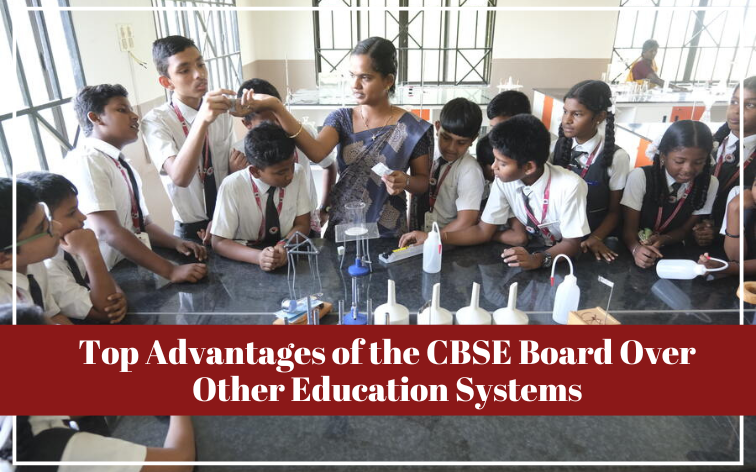
Choosing the right school board plays a crucial role in every student’s academic journey. The advantages of CBSE over other boards are significant, making it a preferred choice for those aspiring toward excellence.
Whether you’re looking for competitive exam support, holistic development, or nationally recognized credentials, CBSE delivers. MVM CBSE Trichy, being affiliated with the CBSE board, ensures students benefit from a consistently robust curriculum and exceptional opportunities.
Advantages of CBSE Over Other Boards
The Central Board of Secondary Education (CBSE) stands apart from other education systems in our country due to its unique curriculum structure, student-centric teaching, and successful track record.
One of the main advantages of CBSE over other boards is its standardized curriculum, which ensures consistency and quality across India. Students moving between states or cities find the transition easy, thanks to the same syllabus and textbooks.
CBSE schools also provide flexibility in choosing subjects, catering to both academic and vocational interests. Compared to state boards, CBSE offers a wider range of electives, preparing students for varied career paths including engineering and medicine.
The curriculum design encourages conceptual learning, problem-solving, and skill application, setting it apart from boards that focus primarily on rote memorization.
How Does CBSE Help in Competitive Exams Like JEE NEET?
For many students in India, clearing exams like JEE NEET is a major milestone on the path to becoming an engineer or a doctor. These exams can feel overwhelming because of the vast syllabus and the level of competition involved. This is where the CBSE curriculum offers a natural advantage.
Since CBSE is structured around the same learning framework used by the National Testing Agency (NTA), students who follow this board often find themselves better aligned with the style and depth of these entrance tests.
The biggest strength of CBSE is its strong focus on NCERT textbooks. These books are not only prescribed for CBSE schools but are also the primary source material for both JEE and NEET. The NTA frequently highlights that students who master NCERT concepts have a significantly better chance of performing well.
This saves CBSE students a great deal of time because they are already familiar with the language, diagrams, examples and explanations used in the exams. They also spend less time switching between multiple reference books, which allows them to revise more effectively.
Another practical benefit of studying in the CBSE system is the emphasis on conceptual clarity. Subjects like Physics, Chemistry and Biology are taught in a way that encourages understanding rather than rote memorisation. This is especially helpful for exams that test problem-solving abilities and not just theoretical recall. By the time CBSE students reach classes 11 and 12, their school learning naturally supports their entrance exam preparation.
Over the years, a noticeably high number of JEE and NEET toppers have come from the CBSE background. Although success ultimately depends on dedication and consistent effort, the alignment of the syllabus and the familiarity with NCERT materials give CBSE students a solid head start.
CBSE instruction helps students reduce unnecessary confusion, focus on what truly matters and prepare more confidently for some of the toughest exams in the country. If a student plans to attempt JEE or NEET, the CBSE board provides a clear and supportive path that makes the journey a little smoother and far more structured.
How Does CBSE Support Holistic Development?
Holistic development is a cornerstone of CBSE’s philosophy. Beyond academics, students learn life skills, team building, leadership, and emotional intelligence. CBSE institutions embed co-curricular and extracurricular activities into the daily schedule, enabling all-round growth.
From art to sports, debate to drama, students discover their strengths and interests that shape bright futures. Holistic development of students is a priority at CBSE schools, fostering adaptable, confident, and creative individuals.
Are CBSE Textbooks Aligned With Competitive Exams?
NCERT textbooks, recommended by the CBSE board, are directly aligned with the materials used in national competitive exams. These books emphasize conceptual understanding and logical reasoning, which are crucial for exams like JEE, NEET, and UPSC.
CBSE students find themselves better equipped for these tests, while students from other boards often need extensive additional preparation to cover exam topics. Using CBSE textbooks makes exam preparation smoother and more focused, especially for highly competitive fields.
Why Choose CBSE Board Over State Board?
Families often ask, why choose CBSE board over the state board? The answer lies in multiple factors. CBSE is nationally and internationally recognized, providing easier admission opportunities for higher education in India and abroad.
State boards like the Tamil Nadu State Board may offer region-specific curriculum, which can be advantageous for regional careers, but CBSE’s curriculum is designed to prepare students for all-India opportunities and global standards.
The emphasis on analytical thinking, flexible subject choices, and frequent curriculum updates ensures that CBSE students remain future-ready. Moreover, with a vast reach and robust support infrastructure, CBSE schools often provide more resources, better guidance, and state-of-the-art facilities. This empowers students to realize their full potential in all aspects: academically, personally, and professionally.
CBSE vs State Board – Key Differences
| Feature | CBSE Board | State Board |
|---|---|---|
| Curriculum Uniformity | Nationally standardized, conceptual learning | State-specific, often rote-based |
| Competitive Exam Alignment | Directly aligned with JEE/NEET, NCERT textbooks | Needs extra preparation for exams |
| Recognition | International and national acceptance | Mostly state-level |
| Skill Development | Holistic, focus on co-curricular activities | Limited, region-specific |
| Flexibility in Subjects | Wide range of electives and combinations | Fewer electives |
| Transferability | Seamless across India | Possible gaps when moving states |
| Exam Patterns | Application-based, MCQs, conceptual | Theory-heavy, straightforward |
| School Infrastructure | Consistently high quality | Varies widely |
| Holistic Development | Embedded in curriculum | Less structured |