For decades, the Indian education system revolved around one metric: Marks. If you scored 95%, you were successful. If you scored 60%, you were average. But does a mark sheet truly capture a student’s ability to debate, code, play sports, or solve real-world problems?
Enter the National Credit Framework (NCrF), a revolutionary policy shift that is set to change how we define academic success.
At Mahalakshmi Vidya Mandir (MVM) Trichy, we believe in staying ahead of educational reforms to guide our parents and students. As the CBSE landscape transforms under the National Education Policy (NEP) 2020, understanding the national credit framework cbse mandates is no longer optional because it is essential.
Whether you are a concerned parent or a curious student, this guide will demystify the national credit framework’s meaning, its implementation, and how it turns every hour of learning into a “credit” for your future.
What is National Credit Framework?
So, what is the national credit framework exactly?
Imagine a bank account, but instead of money, you deposit “learning credits.” The National Credit Framework (NCrF) is a unified system that integrates school education, higher education, and vocational skill training into a single credit-based mobility structure.
Previously, if a student excelled in Vedic Math or Classical Dance outside of school, it did not count toward their Class 10 report card. The national credit framework policy changes this scenario completely. It acknowledges that learning happens everywhere, not just inside four walls. It establishes a “Credit Accumulation and Transfer” system to allow students to “earn” credits for academic subjects, sports, social work, and vocational skills alike.
The 40-Credit Formula: National Credit Framework Credits System
The heart of this new system is the “Notional Learning Hour.” Under the national credit framework guidelines, every hour a student spends learning contributes to their academic bank.
Here is the simple math behind the national credit framework credits system:
- 1 Credit = 30 Notional Learning Hours.
- Total Annual Learning Hours = 1200 Hours.
- Total Annual Credits = 40 Credits.
This means that to “pass” a grade and move to the next level, a student must earn a minimum of 40 credits per year.
Component | Description | Credit Value |
Academic Learning | Standard subjects like Math, Science, English. | Major share of credits |
Vocational Skills | Coding, AI, Carpentry, Pottery, etc. | Integrated credits |
Experiential Learning | Sports, Arts, Yoga, Social Service (NSS/NCC). | Specific credit weightage |
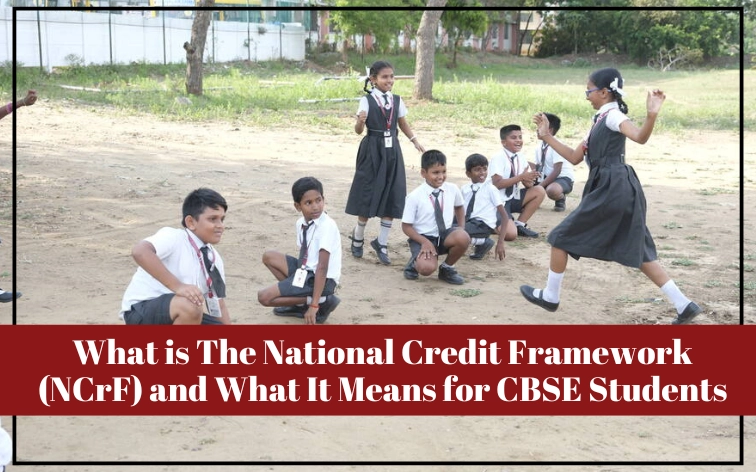
This structure ensures that a student at MVM Trichy who spends 60 hours practicing for a district basketball tournament is earning valid academic credits for that hard work!
National Credit Framework CBSE Implementation: What Changes in Schools?
The national credit framework cbse rollout is a game-changer for school education. The CBSE has already initiated pilot phases in classes 6, 9, and 11 to test this model.
1. No Hard Separation of Streams
The national credit framework school education policy aims to blur the lines between Arts, Science, and Commerce. A student can potentially major in Physics while earning credits for minor courses in Music or History.
2. Holistic Progress Cards
Marks will no longer be the sole hero. The national credit framework cbse implementation mandates that report cards reflect the credits earned across different “baskets” of learning.
3. Vocational Education is Key
As per the national credit framework cbse guidelines, schools must integrate vocational subjects from Class 6 onwards. At MVM Trichy, we are already ahead of the curve, offering robust extracurricular and skill-based programs. You can read more about how we balance this in our blog on Study Techniques for Students.
The Big “Why”: National Credit Framework Benefits
Why is the government pushing for this? The national credit framework benefits are immense for the Indian student:
- Flexibility: It allows for “Multiple Entry and Multiple Exit.” If a student needs to take a break from formal schooling, their earned credits are safely stored in the Academic Bank of Credits (ABC) which is linked to the APAAR ID. They can return later and pick up exactly where they left off.
- Recognition of Talent: A child who is a prodigy in coding but average in History is no longer penalized because their coding hours earn them valuable credits.
- Employability: By integrating vocational training early, students graduate with job-ready skills.
- Global Standard: This system aligns India with international education standards, making admission to foreign universities smoother.
Connecting Schools to Universities: National Credit Framework Higher Education
The beauty of the NCrF is that it does not stop at Class 12. The credits you earn in school form the foundation for national credit framework higher education.
When a student graduates from MVM Trichy and applies to a university, their ABC (Academic Bank of Credits) will show a rich history of 40+ credits per year. Universities will use this data to admit students. In some cases, students may even be able to transfer credits to skip introductory college courses if they have already mastered the skill in school.
Roadmap for 2026 and Beyond
With the CBSE Board Exams evolving, aligning with the NCrF is crucial for students appearing for exams in 2026. Understanding how practicals and internal assessments contribute to your credit score is vital. For a deep dive into upcoming exam patterns, check our CBSE Practical Exams 2026 Complete Guide.
Furthermore, for the latest updates on board strategies, we recommend reading our partner blog on CBSE Board Exam 2026 Preparation Tips.
Download Resources
For parents who want to read the official text, you can access the national credit framework pdf directly from the Ministry of Education website to understand the fine print of the national credit framework policy.
Conclusion
The national credit framework cbse initiative is not just a new rule. It is a new opportunity. It empowers students to own their learning journey. At Mahalakshmi Vidya Mandir, Trichy, we are fully equipped to navigate this transition to ensure your child earns every credit they deserve, both academically and creatively.
Is your child ready for the future of education?
- Visit our Admission Enquiry Page to secure a spot.
- Contact Us for more details on our curriculum.
- Learn more About Us and our vision for holistic learning.
Frequently Asked Questions (FAQs)