The latest changes to the CBSE Board exam structure has made all students go into a tizzy. This means that CBSE class 10 exam tips 2026 need to be very different from the old “just memorize NCERT and write long answers” advice. The 2026 pattern rewards smart strategy, competency based thinking and laser sharp execution in those three hours. This guide is built for class 10 students who want practical, innovative tactics for acing their CBSE board exams 2026.
Understand the 2026 Class 10 Pattern First
Before deciding how to prepare for CBSE 10th board exams 2026, you must know what the paper is really testing. The new pattern gives major weightage to competency based and objective style questions, with the rest for descriptive answers.
Approximate structure for most Class 10 subjects:
Question type | Approx weightage |
Competency based (case, source, data, MCQ) | 40-50% |
Objective type (very short, 1 mark) | 20% |
Short and long descriptive answers | 30-40% |
Theory marks (board paper) | 80 |
Internal assessment | 20 |
After going through this structure, you can understand that CBSE class 10 exam tips 2026 must focus heavily on application questions, not just theory reading.
Read Also: CBSE Examination Tips 2025
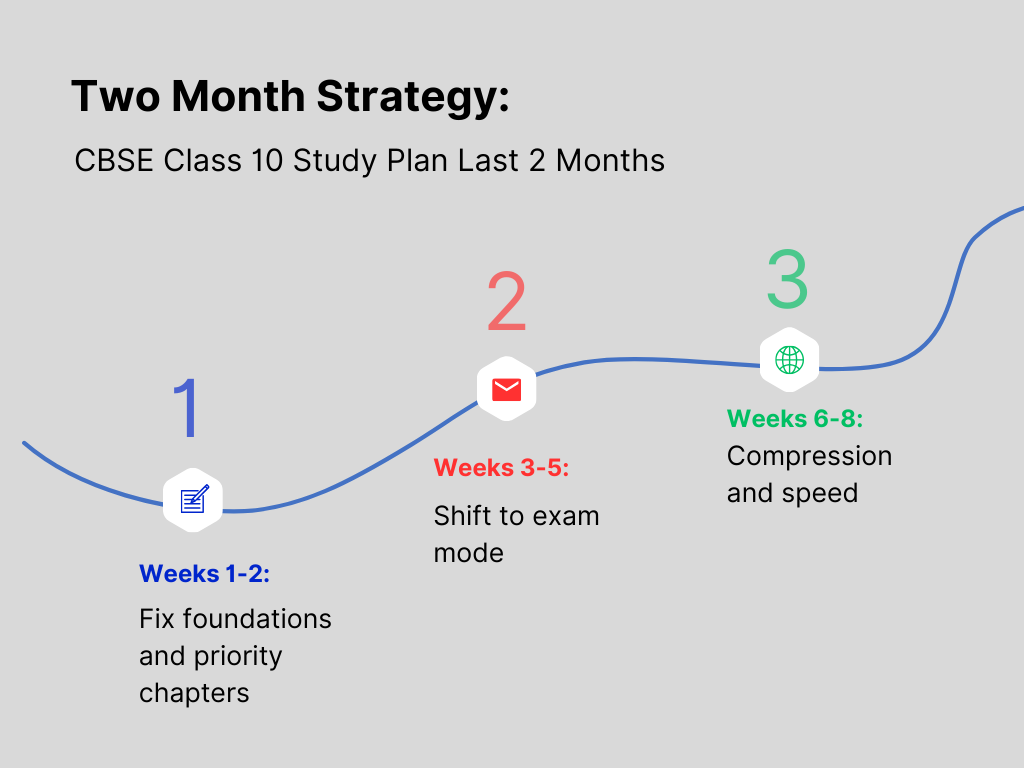
Two Month Strategy: CBSE Class 10 Study Plan Last 2 Months
The last eight weeks decide everything. Here is a realistic CBSE class 10 study plan last 2 months based on how previous year toppers and the teachers in the best CBSE school in Trichy structure their final push.
Weeks 1-2: Fix foundations and priority chapters
- Mark chapters with high weightage using the latest syllabus and blueprint.
- For each subject, complete one “priority list” of 8-10 must be perfect chapters.
- In these two weeks, do concept drilling and exemplar questions, not full papers.
Weeks 3-5: Shift to exam mode
- Start one full subject test every alternate day using CBSE 10th sample papers prep strategy.
- After each paper, spend equal time on post exam analysis: where you lost marks, which topics repeat, what types of questions eat your time.
- Build a “mistake notebook” where you rewrite only your wrong or weak questions, with corrected solutions.
Weeks 6-8: Compression and speed
- Reduce fresh learning; move to rapid mixed revision.
- Attempt mixed subject tests across 2-3 subjects in a week to simulate the real timetable.
- Use your mistake notebook as the main revision source in the final 10 days.
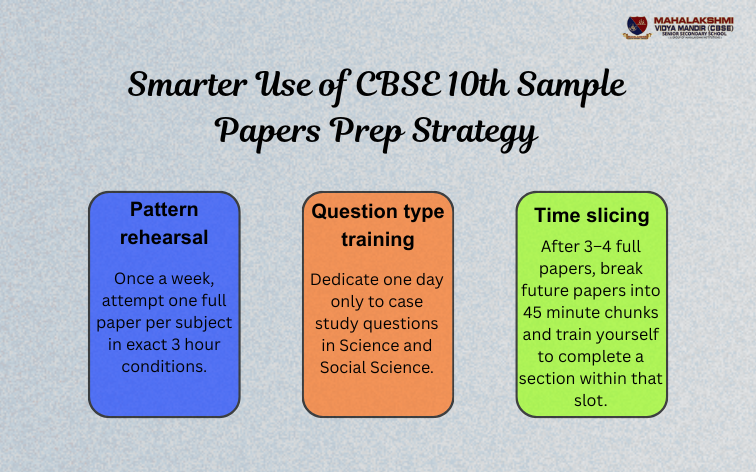
Smarter Use of CBSE 10th Sample Papers Prep Strategy
Most students simply “solve sample papers.” Effective CBSE 10th sample papers prep strategy is very different.
Use sample papers in three specific ways:
- Pattern rehearsal
- Once a week, attempt one full paper per subject in exact 3 hour conditions.
- Follow the new pattern distribution for competency and MCQ questions taken from official and reputed sample paper sets.
- Question type training
- Dedicate one day only to case study questions in Science and Social Science.
- Another day only for competency based word problems in Maths.
- This builds pattern recognition so your brain says “I have seen this logic before” in the exam.
- Time slicing
- After 3–4 full papers, break future papers into 45 minute chunks and train yourself to complete a section within that slot.
- This directly improves CBSE 10th time management during board exam.
Deep Work Blocks: How to Prepare for CBSE 10th Board Exams 2026 Daily
For Trichy students juggling school, tuition and travel, random studying does not work. You need 2–3 daily “deep study blocks” of 45–60 minutes.
Here is a proven structure for each block:
- 5 minutes: Quick recap of yesterday’s topic.
- 30–35 minutes: Focused problem solving or answer writing (no phone, no switching subjects).
- 10 minutes: Self checking with marking scheme or solution.
- 5–10 minutes: Writing the key learning or formula into a compact notebook.
Do this twice daily for Maths and Science on weekdays, and once for Social Science plus languages, and you will complete far more targeted work than 4–5 hours of distracted studying.
CBSE 10th Time Management During Board Exam
The three hours timeline decides the foundation of your career. Therefore CBSE 10th time management during board exam is all about proper planning and management of your resources
A Sample Breakdown For Students:
Time block | Task |
First 15 minutes | Read whole paper, mark easy/medium/tough questions |
Next 30 minutes | Finish all MCQs and very short answers |
Next 60 minutes | Attempt all short answers and mid level questions |
Next 45 minutes | Long answers, case studies, numerical problems |
Last 30 minutes | Review, complete skipped parts, clean diagrams |
Key tips:
- Start with questions you can do in under 2 minutes to build momentum.
- Put a small star near any question you skip so you can quickly find it later.
- Never spend more than 7–8 minutes on a single long answer in the first go.
CBSE 10th Revision Tips for High Marks
Students often search CBSE 10th revision tips for high marks and only find “revise daily, make notes.” Here are more innovative options backed by how memory works.
- One page per chapter rule
- Force yourself to summarise each chapter on a single A4 page using diagrams, arrows and keywords.
- Stick these on your wall; in the last week, only these sheets and your mistake notebook are allowed.
- Audio recall for theory subjects
- Record yourself explaining important Social Science answers or long theory in Science in simple language.
- Listen during commutes across Trichy or while walking; this uses dead time for spaced repetition.
- Cross subject pattern linking
- Notice how competency based questions in Maths, Science and Social Science all follow similar logic: real life context, data, and an inference.
- Train yourself to first “decode” context, then extract data points, then answer. This one method boosts scores across three subjects.
- Night before micro plan
- For each exam, the night before, write a 6 line plan: which 6 mini topics or question types you will just quickly glance at in the morning.
- This stops mindless last minute panic reading.
Putting It All Together: Compact Playbook
Here is a quick integrated view that you can pin on your wall:
Goal | Tool or habit |
Understand pattern | Read latest exam pattern and sample paper design |
Build 2 month finish plan | Use CBSE class 10 study plan last 2 months blocks |
Master question types | Structured CBSE 10th sample papers prep strategy |
Control the 3 hour performance | Follow CBSE 10th time management during board exam plan |
Boost memory and application | Use innovative CBSE 10th revision tips for high marks |
Stay updated to 2026 changes | Track competency based question practice |